Disclaimer

WEBSITE CONTENT: All written content on this site is for information purposes only. Opinions expressed herein are solely those of Wu Wealth Advisory, LLC (WWA) unless otherwise specifically cited. Material presented is believed to be from reliable sources and no representations are made by our firm as to another parties’ informational accuracy or completeness. All information or ideas provided should be discussed in detail with an advisor, accountant or legal counsel prior to implementation.
This website may provide links to others for the convenience of our users. Our firm has no control over the accuracy or content of these other websites.

REGISTRATION INFORMATION: Advisory services are offered through Wu Wealth Advisory, LLC, a registered investment advisor domiciled in the State of New York. The presence of this website on the Internet shall not be directly or indirectly interpreted as a solicitation of investment advisory services to persons of another jurisdiction unless otherwise permitted by statute.
Follow-up or individualized responses to consumers in a particular state by our firm in the rendering of personalized investment advice for compensation shall not be made without our first complying with jurisdiction requirements or pursuant an applicable state exemption.
For information concerning the status or disciplinary history of a broker-dealer, investment advisor, or their representatives, a consumer should contact their state securities administrator.
WWA will provide all prospective clients with a copy of our current Form ADV, Part 2A (“Disclosure Brochure”) and the Brochure Supplement for each investment advisor representative. You may obtain a copy of these disclosures on the SEC website at https://adviserinfo.sec.gov/Firm/299120 or you may contact us at (917) 868-3009 or by email at info@wuwealth.com to request a free hardcopy or in PDF format.

Insights

A New Trump Administration & You

In light of the fairly significant changes wrough by the recent US elections, the below represents what I perceive to be possible clouds on the horizon–
 
 
1) Immediate Threat (< 1yr.)
 
Scenario: Imposition of Protectionist Tariffs
Any administration has wide latitude in imposing trade tariffs, without counterbalancing “interference” from the other two branches.  Given the president-elect’s “transactional” reputation towards policy-making, I strongly suspect we will likely see the erection of trade barriers, not dissimilar to what was done during the first term when tariffs were imposed on goods valued at approximately $380 billion in 2018 and 2019, 
 
Any student of Econ. 101 knows that consumers pay the ultimate price under a trade war, as they bear the brunt of heighted costs relating to supply chain distruptions and retaliatory tariffs.
 
 
2) Longer-Term Threat (>1 yr.)
 
Scenario: Higher Interest Rate Environment
The 2017 tax cuts have resulted in increases in the overall US national debt; by one measure, $1T – $2T will have been added to the debt load when some provisions sunset next year.  With at least control of the US Senate, if not the House as well, it is widely expected further tax cuts will be likely.  To fund any tax cuts through the issuance of more US Treasuries, there exists a distinct risk that rates will have to be higher to entice institutional buyers.
 
Notwithstanding this possibility, a plurality of the Street is still expecting a total rate cut of 0.75% between now and the end of 2025.  This apparent disconnect is beyond the purview of this quick note.
 
Mitigating Factor(s)?
Inherently, it’s extremely difficult to speculate on interest rates, especially when trying to predict beyond the 1-year timeframe.  Furthermore, this sustained, higher rate scenario is predicated upon the premise of additional tax cuts/fiscal stimuli, the details of which are non-existent at present.  Finally, the Federal Reserve has the tools to blunt, at least partially, expansionary fiscal measures through its operations.
 
We will be paying closer attention in light of these unknowns.  As always, I stand ready to provide a more bespoke analysis of how the above may impact your particular situation.

Initial Thoughts on Results of US Elections

It appears the GOP has won both the Presidency and US Senate, with control over the House remaining up in the air.  Notwithstanding the incomplete results, here’re some initial takes on potential implications for your personal finances:
 
TAXES: Some key provisions of the 2017 tax cuts (eg. lower income tax rates, higher estate tax & standard deduction amounts) will likely be extended, beyond its sunset date of 2025;
 
BUSINESS: Dealmaking would probably accelerate, given the expected lessening of regulatory oversight;
 
EQUITIES: A positive bias owards further gains in US equities, especially now that the overhang over election uncertainties has been lifted;
 
INFLATION: Economic policies (whether as they relate to taxation or USA-first trade policies) would most likely add to inflation.  To what extent the Federal Reserve can counteract against expansionary pressures will impact Street expectations of Fed rate cuts over the next year;
 
GEOPOLITICS: Given the incoming Administration’s image of a more “transactional” approach towards foreign policy, the risks of unexpected US trajectory can’t be ignored.
 
Kindly note this caveat– the above observations are subject to revision to the extent that campaign rhetoric may prove quite different from actual governance.  In either case, I remain ready & available to examine how any of the above may impact your positioning towards goals, both near- and longer-term.

Is the U.S. Already In A Recession?

Unbeknown to most in the public, a group of eight economists from the nonprofit National Bureau of Economic Research is the official arbiter of US business cycles.  Given its opaque deliberations and indeterminate meeting dates, it’s not surprising that both Main Street and Wall Street have resorted to a whole host of data to predict such cycles in a timelier manner.

The release of notably weaker-than-expected July jobs report this past Friday has ignited some buzz on one such indicator—the Sahm rule.  Triggered in every recession since 1970, the rule holds that a recession is almost always already underway, if the three-month average unemployment rate is 0.5% higher than the lowest point in the preceding 12 months.  The Rubicon was crossed for the first time since 2/2020 when Covid began.

How significant is this event?

In deciphering the strength of any economy, a panoply of indicators is required to make a more accurate assessment.  Currently, the Sahm rule’s warning of a slowdown in the economy is unmistakable. That said, one would do well to avoid overstating its stand-alone value at present, when: 1) the sample size is relatively small (only 8 recessions since 1970), heightening the risk of correlation-causation fallacy; and 2) the distortions from the unprecedented Covid-related fiscal and monetary stimuli totaling at least $10T, or 40% of annual US GDP, have yet to be fully understood.

Juxtaposed against this potential flirtation with recession, the Fed once again finds itself in an unenviable position.  While inflationary measures have been trending lower, they are not near the central bank’s stated goal of 2%.  Notwithstanding, the Street is now anticipating at least one full percentage point in rate cuts between now and year-end, as fears of economic deceleration grip investors.

While the term “curated” has been used so frequently as to become hackneyed, the idea that any investment portfolio should be tailored remains perpetual and immune to fads.  How’s your portfolio positioned in this macro environment?

Is This A Head Fake?

I hope everyone has remained safe and healthy during this extraordinary period.


As I write this on Friday morning (April 17), the US equity market is buoyed by further anecdotal evidence — though unsubstantiated by peer-review — that one treatment now in a clinical trial may prove promising as a COVID-19 therapeutic. As glaring and painful as the recent torrent of red may be on any account statement, the S&P 500 is only approximately 14% off the all-time high reached on 2/19/2020.


So, does this represent an inflection point where the “all-clear” signal has been heralded? Far from it, as I will discuss in what follows.


Indeed, I believe investors, understandably thirsty for developments suggestive of a quick market and economic recovery, may be guilty of “confirmation bias.” This myopic tendency is best described as our psychological preference for information that validates our pre-existing beliefs while ignoring disconcerting evidence to the contrary. At present, the investing public appears to be betting dislocations arising from the pandemic will be short-lived, and then using the powerful rally from the March 23 lows to confirm the cheerful hypothesis.


Is this optimism misplaced? Not entirely.


To be certain, the market was prevented from an unrestrained free-fall by three interim developments: 1) the Federal Reserve’s decision to place the weight of its balance sheet on minimizing damage to the country’s credit system; 2) Congress’ passage of the over $2 trillion relief bill, with more on the horizon; and, 3) signs that infection rates may have peaked for now in coastal states where the outbreak ravaged first.


Nevertheless, there is a known set of unknowns which may not have been fully discounted by the market. Most notably, in the short-term:


1) Dismal Unemployment Picture— According to the log-scaled chart (below) compiled from data kept by the St. Louis Federal Reserve, a record 5.245 million Americans filed first-time claims for unemployment insurance as of 4/11/2020 (dark blue line on right), bringing the crisis total to just over 22 million (13% of total US labor force) and nearly wiping out all the job gains since the Great Recession. The weekly unemployment claims figure is one of the few useful coincident indicators permitting a snapshot of the present economic condition.


Historically, spikes in unemployment claims have been accompanied by recessionary periods of varying lengths (light grey shaded areas). According to the National Bureau of Economic Research, the most painless recession lasted 6 months in 1980, with an average of almost 1 year in the last 11 business cycles since 1945. Given the depth of job displacement already evident, it is difficult to envision this recession will be a fleeting mirage. Even under the best case scenario of an accelerated resumption of economic activities in the second half of this year due to pent-up demand, the financial damage already wrought upon the balance sheets of many US households, those representing 70% of the economy, will likely temper and alter consumptive behavior and impact confidence in 2020 and beyond.
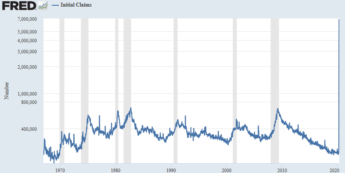
 

Source: Federal Reserve Bank of St. Louis, Retrieved 4/16/2020 at https://fred.stlouisfed.org/series/ICSA


2) Full Extent of Economic Damage— Economists at the New York Federal Reserve have recently developed a new Weekly Economic Index, designed to capture factors influencing GDP trends. The WEI is currently -11.04 percent for the week ending April 11 and -8.42 percent for April 04; for reference, the WEI stood at 1.58 percent for the week ending February 29.


This reading of -11% means that if current weekly conditions persisted for an entire quarter, the Index would expect, on average, a negative 11 percent GDP growth relative to a year prior. While economic conditions are never static, the speed of economic deceleration in recent weeks is irrefutable and particularly alarming, especially in light of uncertainties vis-à-vis the lifting of lockdowns to varying degrees in different parts of the country.


3) Inevitable Force of History— Like many Wall Street truisms acting as security blankets for some, it has been often repeated that no two market cycles are ever the same and that things will be different this time around. Such utter ignorance of history is unwarranted, though, because history serves as a useful check on our expectations for the future as well as provides some framework of analysis.


Since 1926, the average bear market lasted 1.3 years, with three months being the shortest, according to First Trust Portfolios. Moreover, the peak-to-trough declines in the dot.com bubble and the Great Recession were 49.1% and 56.4%, respectively. As applied to the US equity market, which has recovered strongly over the last month, the current drawdown of only 14% suggests this bear market, which only began in late March, portend additional risks to the downside in next three months, at least.


4) Inestimable Variables in Pandemic— Any assessment of economic fallout is challenging precisely because it is dependent upon factors which remain ill-understood, including the pathway of future outbreaks, efficacy of containment efforts, credible therapeutics for those fallen ill, and development of vaccines to mitigate future waves of infections.


Juxtaposed against this array of public health exigencies lies the no less urgent existential need to reopen the economy, especially critical for those temporarily furloughed and their small-and-medium business employers. The astute finesse required to manage this tension cannot be overstated as any reopening guidelines based upon flawed modeling will likely result in further delay in returning to “business as usual.”


Given these near-term challenges, the resolution of which remains uncertain, any unbridled exuberance tied to the ongoing market upswing is unjustified. If nothing else, current market volatilities remind us of the importance of assessing and understanding risks we already assume in our portfolios. For most investors, caution and risk mitigation should remain the overarching themes of any such critical examinations.


Take extra good care of yourself and each other!